
Intra-Sectionality of Ableism and Gender Equity.
On International Women's Day 2026

Every year, I write about International Women’s Day from a disability perspective. Disabled women and femme-identifying people experience additional discrimination, often described through the concept of intersectionality — when forms of inequality such as racism, sexism and ableism overlap to create unique, compounded, and often overlooked forms of discrimination.
This year, after attending the Australian Disability Strategy Forum, I was introduced to another concept that helped explain a frustration I have long felt in women’s spaces: intrasectionality, a term introduced by Dr Scott Avery.
While intersectionality helps explain how overlapping identities shape discrimination across society, it does not always fully capture the dynamics of discrimination occurring within identity-based communities themselves.
Intrasectionality describes interpersonal dynamics and discrimination that occurs within identity-based communities themselves, not just between dominant and marginalised groups. It highlights what happens inside communities that are themselves seeking equality.
Intrasectionality describes my frustration, as a disabled woman, with gender equity approaches.
In this edition, I will explore intrasectionality in women’s spaces and provide some practical points for addressing ableism within women’s spaces, initiatives, communities and organisations.
International Women’s Day increasingly feels reductive
“I’m sick of being reduced to a single characteristic without consideration for the whole person.” I wrote in the Substack chat. “I’m a cis woman, and I’m disabled, and I’m a mother, and I’m in a queer relationship. Inclusion because of my gender, without consideration for everything else, is reductive. As I’m sure it is for First Nations, POC, immigrants, and racially and culturally marginalised women/folks.”
I ended with “I wonder if it’s preventing us from achieving the desired gender equity.”
Is it the ableism I experience in women’s spaces that makes me feel excluded from gender equity efforts?
For the avoidance of doubt, by women, I mean people who identify as women, as well as femme-identifying non-binary folk. I wrote about trans as natural human variation in a previous edition, and I want to reiterate
Trans rights do not impinge on mine.
Trans oppression impinges on my rights as a cis woman and a person with medical needs.
Targeting trans people, young and old, is a gateway to the oppression of women and girls.
If anything, attacks on trans people often become the testing ground for restricting the rights of women and girls, disabled people, those with medical needs, and other minorities.
Introducing intra-sectionality
Intersectionality is about systems; it reminds us that people are not one thing at a time. When systems ignore that complexity, exclusion multiplies, and a third discrimination occurs.
While intersectionality helps explain how overlapping identities shape discrimination across society, it does not always fully capture the dynamics of discrimination occurring within identity-based communities themselves - the very thing I find frustrating on International Women’s Day.
Bruno Perreau’s concept of intrasectionality, and Dr Avery’s use of it at the Forum, draws attention to this gap through consideration of interpersonal relationships within communities
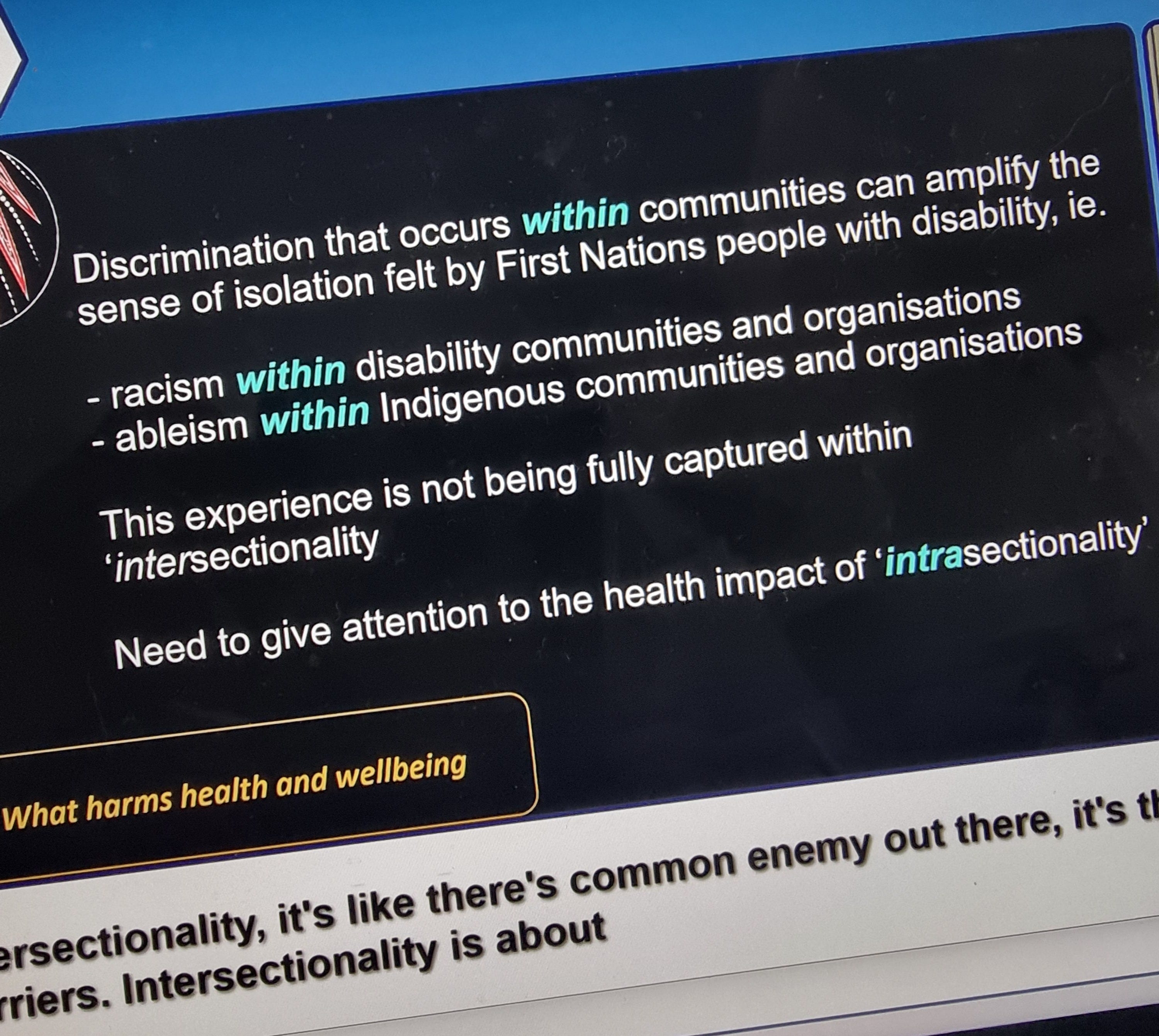
In Dr Avery’s work, recognising intrasectionality is therefore essential to designing services, policies and community initiatives that genuinely support First Nations people with disability.
We see sexism within disability spaces. For example, rates of disability remain relatively similar between men and women, yet women make up one-third (37%) of NDIS participants. How can this be?
Let’s apply intrasectionality to women’s spaces
Abelism within women’s spaces, initiatives, communities and organisations
Sexism within women’s spaces, initiatives, communities and organisations
Racism within women’s spaces, initiatives, communities and organisations
Transphobia within women’s spaces, initiatives, communities and organisations
Islamophobia within women’s spaces, initiatives, communities and organisations
Heteronormativity within women’s spaces, initiatives, communities and organisations
Ageism within women’s spaces, initiatives, communities and organisations
Abelism within women’s spaces, initiatives, communities and organisations.
Women are more likely to be the carers of children, parents or community members with a disability. Gender equity strategies that fail to address, promote and provide flexibility for women will fail to address the practical barriers to workplace participation.
A practical set of resources to address ableism in women’s spaces goes further than flexible work, as provided for in Australia’s Fair Work Act. It must also include the far more comprehensive protections provided by the Disability Discrimination Act, which can include workplace adjustments such as changes to hours, rosters, location, or days of work, and apply to carers of and people with a disability.
Accessible and inclusive gender equity meetings, events and content. If disabled women/folks cannot join the conversation, they are excluded from developing the very strategies, policies and initiatives designed to include them. A practical set of resources to ensure accessible and inclusive social media and communication for those working towards gender inclusion is available on my website.

The point I keep repeating: Trickle-down diversity is not a thing. You have to choose to include.
Gender equity strategies often feel singular and reductive because they treat women as if gender is the only thing about us that holds us back.
But women are not one thing at a time. Disability, race, sexuality, culture, class and caring responsibilities all shape how inequality is experienced.
And too many strategies address this complexity by hoping for a trickle-down diversity effect; the idea that as women rise, they will bring others up with them. But like trickle-down economics, it rarely works in practice.
As I’ve said for the past few years
“I want white, not-yet-disabled, cis gender, heterosexual corporate women to stop worrying about the inattention of white, not-yet-disabled, cis gender, heterosexual corporate men and understand their privilege. The role they so desperately want these men to play is the role non-white, disabled, LGBTQIA+ women/folk want them to play in support of true gender equality. Trickle-down diversity is not a thing; you have to choose to include.” - Briar Harte
Starting today, pause and consider who your gender equity work is designed for, and who it unintentionally leaves out. Then deliberately design gender equity strategies that disabled women can actually access, participate in and shape.
Inclusion does not trickle down. It is chosen.
“You cannot re-centre people who have been living at the margins just by inviting them in. They won’t fit. You need to change the structures and systems so that they belong at the centre when they first arrive.” - Logan Gin
Unlearning Prompts
Consider unlearning
How does intra-sectionality change your views of ableism or sexism?
Where have you seen intrasectionality show up in spaces that are supposed to be inclusive?
Where might discrimination be occurring within your own community or initiative, not just outside it?
Do your gender equity initiatives assume trickle-down diversity?
What is one thing you could change tomorrow to make a women’s initiative, meeting or event more accessible?
Join the unlearning.
If you found the idea of Intrasectionality useful, please forward it to someone who might also enjoy it.
My work is geared towards shifting systems to take the pressure off disabled people. You can subscribe to learn with me. I’ll share what I learn (and unlearn) about accessibility, inclusion and disability. Together, we can build more impactful commercial and human outcomes.
I love the term "trickle down diversity." I wish more people understood that having one woman in the c suite doesn't mean the rest of the women in the company are now being treated or being paid as well as the men.